Kenneth Sinclair-Loutit: A Legacy of Ideals and Action
Kenneth Sinclair-Loutit remains an inspiring figure in the annals of modern history, primarily due to his impassioned involvement in the Spanish Civil War and his unwavering commitment to the ideals of democracy and social justice. Born into a family of modest means in the early 20th century, Kenneth grew up during a period of global unrest and ideological shifts. These formative years instilled in him a deep sense of responsibility to combat oppression and support the principles of liberty and equality wherever they were threatened.
I never knew him well as he and Thora divorced when my mother was still young. But his life represents a fascinating insight into the political history of the 20th century.
Early Life and Influences
Kenneth was born in 1910 in Birmingham, England, to a politically conscious family. His parents were active members of the local Labour movement, fostering in Kenneth a keen awareness of the struggles of working-class people. He was an avid reader, devouring works by political thinkers such as Karl Marx, George Orwell, and John Stuart Mill. These influences laid the groundwork for his belief in the importance of democracy as a vehicle for human dignity and progress.
During his university years at Cambridge, Kenneth became heavily involved in student politics, joining debates and participating in protests advocating for workers’ rights and international solidarity. The rise of fascism across Europe in the 1930s profoundly alarmed him, as he saw authoritarian regimes dismantle democratic institutions and erode freedoms. When the Spanish Civil War broke out in 1936, Kenneth felt compelled to act.
Involvement in the Spanish Civil War
The Spanish Civil War, fought between 1936 and 1939, was a pivotal conflict in Europe’s prelude to World War II. The war pitted the democratically elected Republican government, supported by leftist factions, against the Nationalist forces led by General Francisco Franco, who sought to impose a fascist regime. For Kenneth, the stakes were clear: the Spanish Civil War was not just a battle for control of Spain but a larger struggle for the future of democracy in Europe.
Kenneth joined the International Brigade, a volunteer force composed of individuals from across the globe who travelled to Spain to defend the Republican cause. His decision was not made lightly; he left behind a promising academic career and a comfortable life to join a war-torn country where the odds were stacked against the Republicans. This act exemplified his deep conviction that democracy and human rights were worth fighting for, even at great personal risk.
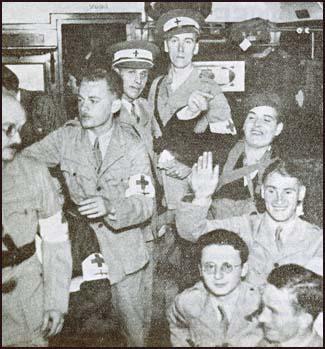
Members of the British Medical Unit leaving on 23rd August 1936. Kenneth Sinclair-Loutit is standing in the middle of the photograph at the back.
In Spain, Kenneth served primarily as a communications officer, responsible for ensuring that orders and information were relayed between units. His linguistic abilities—he had diligently learned Spanish before embarking on his journey—made him an invaluable asset to his brigade. Beyond his official role, Kenneth also wrote extensively about his experiences, contributing articles to international newspapers and journals. His writings provided vivid, firsthand accounts of the war, highlighting both the heroism of his comrades and the devastating toll the conflict took on civilians.
Kenneth was not just a soldier but also a fierce advocate for the Republican cause. He believed that the Republican government represented a fragile yet vital experiment in social democracy, one that sought to address deep-seated inequalities in Spanish society. The Nationalist forces, on the other hand, symbolised the encroaching tide of fascism that threatened to engulf Europe. To Kenneth, defending Spain’s democracy was a moral imperative, as its defeat would embolden authoritarian regimes elsewhere.
Challenges and Losses
The war was brutal, and Kenneth faced profound challenges during his time in Spain. He witnessed the horrors of modern warfare, including aerial bombings of civilian populations and the atrocities committed by Francoist forces. Many of his closest friends and comrades were killed in battle, leaving an indelible mark on him. Despite the adversity, Kenneth remained resolute, driven by the belief that his efforts, however small, were contributing to a larger, noble cause.
However, the Republican forces were ultimately outmatched. Franco’s Nationalists received substantial military support from fascist Italy and Nazi Germany, while the Republicans struggled with limited resources and internal divisions. In 1939, as the war drew to a close with the Nationalists’ victory, Kenneth was forced to flee Spain. The loss of the war was a devastating blow to him, as it signalled not only the end of Spanish democracy but also the growing strength of fascist regimes in Europe.
Legacy and Reflections
Despite the Republican defeat, Kenneth’s commitment to the ideals of democracy and justice did not waver. Upon returning to England, he continued to advocate for Spanish democracy, raising awareness about the plight of refugees and the brutal repression under Franco’s regime. He joined various anti-fascist organisations and worked tirelessly to support efforts to restore democracy in Spain.
Kenneth’s writings from the war became a powerful testament to the human cost of fascism and the enduring importance of democratic principles. His essays and memoirs were widely read, serving as both a cautionary tale and a call to action for future generations. He emphasised the interconnectedness of global struggles for democracy, arguing that the fight against tyranny in one nation was intrinsically linked to the defence of liberty everywhere.
Kenneth also remained a vocal critic of the Western powers’ failure to adequately support the Spanish Republic. He believed that this inaction not only condemned Spain to decades of dictatorship but also emboldened fascist regimes, contributing to the outbreak of World War II. His reflections on this period were deeply analytical, underscoring the necessity of international solidarity in the face of authoritarianism.
The Importance of Spanish Democracy
Kenneth Sinclair-Loutit’s life and work underscore the enduring significance of Spanish democracy, not just for Spain but for the world. The Spanish Civil War was a crucible in which the values of liberty, equality, and justice were tested under the harshest conditions. While the Republic ultimately fell, its ideals continued to inspire movements for democracy and human rights around the globe.
For Kenneth, Spanish democracy was a symbol of hope—a reminder that even in the face of entrenched power and inequality, people could come together to create a fairer, more just society. He believed that the Republic’s efforts to implement land reform, expand education, and protect workers’ rights were vital steps toward building a more equitable world. These aspirations resonated with Kenneth’s broader vision of a society rooted in democratic principles and social justice.
Today, Kenneth Sinclair-Loutit’s legacy serves as a reminder of the sacrifices made by countless individuals in the struggle for democracy. His involvement in the Spanish Civil War highlights the profound impact that ordinary people can have when they choose to stand against tyranny and fight for the common good. As the world continues to grapple with challenges to democratic values, Kenneth’s story remains a powerful testament to the enduring importance of courage, conviction, and collective action.